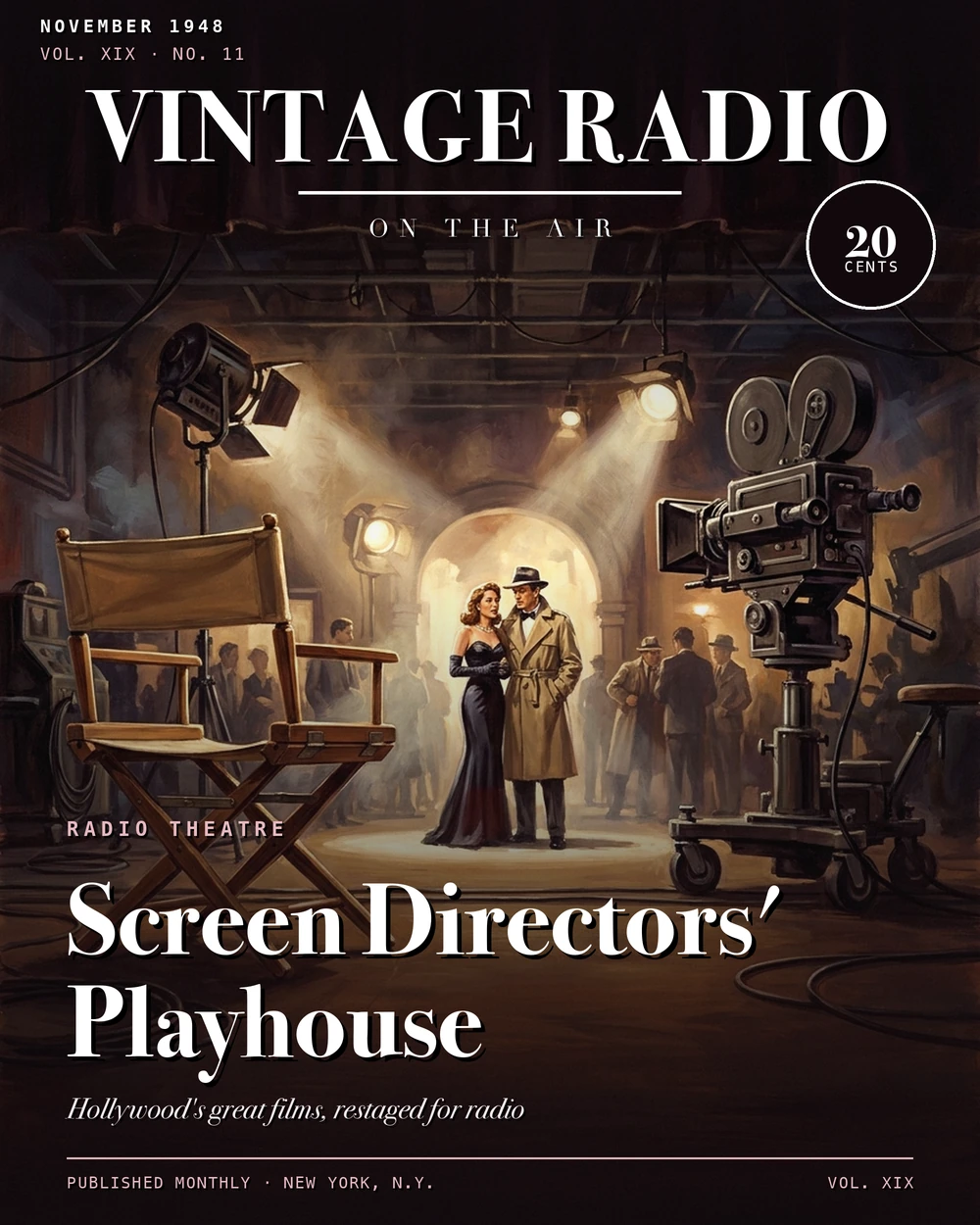
Screen Directors' Playhouse
The Angle That Set It Apart
What separated Screen Directors' Playhouse from every other Hollywood glamour program on the radio dial was the directors. Shows like Lux Radio Theatre had been bringing famous film adaptations and big-name stars to radio audiences for years, and by 1949 the formula was well worn. Screen Directors' Playhouse followed the same basic idea — take a famous movie, cast the original stars or comparable names, and present a polished half-hour or hour-long radio version — but it added something nobody else was doing: the directors of those original films came on the air, introduced the adaptations, and then sat down afterward with the cast to talk about how the movies had been made and what everyone had done since.
This wasn't a gimmick. The Screen Directors Guild was formally involved in the production, helping select the directors and approve scripts, and it used the income the program generated to support its educational and benevolent foundation. That organizational backing meant the participation was genuine — directors weren't just lending their names to a credit. John Ford was on the premiere episode, talking with John Wayne, Claire Trevor, and Ward Bond about making Stagecoach. Billy Wilder not only introduced the adaptation of his film A Foreign Affair but took an acting role himself, playing a black-market waiter in the Lorelei Club. The show opened its announcement with the line: "SCREEN DIRECTORS PLAYHOUSE. Bringing you each week an outstanding original screenplay chosen and directed by one of the country's foremost motion picture directors." That was the contract with the audience.
Creator Don Sharpe had a clear philosophy about what made radio packages work. He believed that "writing is the most important single factor in a radio package," and Screen Directors' Playhouse was built around that conviction. Writers Dick Simmons and Milton Geiger handled the adaptations, cutting feature-length films down to fit the radio format while keeping the essential plot intact. The combination of skilled adaptation and the directors' personal involvement gave the show a texture that the glossier Hollywood anthology programs often lacked.
How It Got Started
Screen Directors' Playhouse debuted on NBC on January 9, 1949, under the name NBC Theater, filling the 8:30 p.m. Eastern Sunday slot left open when Fred Allen's program departed. For its first several months it ran without a commercial sponsor as a sustaining program, which the network was willing to accept while building an audience and searching for a bankroller. By March 1949 it had moved to the 9:00 p.m. Sunday slot.
The show's first sponsored run came in the summer of 1949, when it shifted to Friday evenings from 8:30 to 9:00 as a replacement for Eddie Cantor's program, with Pabst Brewing Company picking up the tab. The name change to Screen Directors Playhouse accompanied that Pabst sponsorship, arriving on July 1, 1949. Billboard reported that NBC had discounted the show's price for this run, with the network reportedly wanting to "snare a bankroller during summer months even at a loss, thus cutting its overhead on the show and getting sponsorship prestige." After the summer run, the show moved to Mondays at 10:00 p.m., then in November 1949 settled into Fridays at 10:00 p.m. as a sustaining show again until RCA came on as sponsor in January 1950. RCA, Anacin, and Chesterfield all held sponsorship roles during the 1950–51 period.
Producer Howard Wylie and director Bill Karn ran the production, with Jimmy Wallington as announcer and Henry Russell leading the orchestra. The show used an interesting production technique during its early period: episodes mixed recorded dialogue with live musical components, with engineers synchronizing taped segments with live bridges and themes to reduce musicians' fees. By November 1950, the program had moved to pre-recorded musical elements entirely.
The industry recognized the show early. In November 1949, the National Council of Teachers of English gave NBC Theater its award as the program that had done most during the 1948–49 school year "to promote greater understanding and appreciation of our literary heritage." That December, the program came in as a second-place selection for outstanding entertainment in drama at the Peabody Awards.
The Stars and the Stories
The roster of performers who appeared on Screen Directors' Playhouse reads like a studio contract list from the peak years of Hollywood. Fred Astaire, Tallulah Bankhead, Charles Boyer, Claudette Colbert, Ronald Colman, Gary Cooper, Joan Crawford, Bette Davis, Marlene Dietrich, Irene Dunne, Douglas Fairbanks Jr., Henry Fonda, Cary Grant, William Holden, Burt Lancaster, James Mason, Ray Milland, Gregory Peck, William Powell, Norma Shearer, and Loretta Young all appeared, alongside many others.
The films adapted ranged across genre and era: The Best Years of Our Lives, Mr. Blandings Builds His Dream House, It's a Wonderful Life, Jezebel, Call Northside 777, One Way Passage, The Human Comedy, The Magnificent Obsession, and more. Kirk Douglas came on for Champion, Lucille Ball for Miss Grant Takes Richmond, Edward G. Robinson for both The Sea Wolf and The Night Has a Thousand Eyes. Dick Powell and Jane Wyatt appeared in Pitfall, and Dorothy McGuire in The Spiral Staircase. Among the most notable episodes was All My Sons, based on the Arthur Miller play, starring Robinson alongside Jeff Chandler — a gripping, powerful piece of radio drama by any standard.
One episode carried a particular novelty. Margaret Truman, the president's daughter, made her first dramatic acting appearance on radio in the hour-long episode Jackpot, alongside James Stewart. It was the kind of casting that landed outside the usual Hollywood circuit.
The Expansion to an Hour
On November 9, 1950, Screen Directors' Playhouse expanded from its half-hour format to a full hour per week. The trade publication Radio Life applauded the change, stating: "It takes a full hour's time, at least, to transfer effectively a good screenplay into the medium of sound." The longer format gave the writers room to handle the material more fully, and the productions in the hour-long run carried that additional weight.
Tallulah Bankhead appeared in the hour-long Lifeboat. Joseph Cotten came on for Mrs. Mike. Barbara Stanwyck appeared in The Lady Gambles. The expanded slot also allowed the post-episode conversations with the directors to breathe more naturally, turning what had been brief exchanges into genuine reminiscences about the filmmaking process.
The show ran 122 episodes across its various titles — NBC Theater, Screen Directors Guild Assignment, Screen Directors Assignment, and finally Screen Directors Playhouse — before going off the air on September 28, 1951. It arrived at a crowded moment in radio history, when the airwaves were full of Hollywood anthology programs that followed the same general template. What kept Screen Directors' Playhouse distinct was not its cast list, which any competing show might have matched, but the quality of the adaptations and the genuine involvement of the directors who had made the original films.
The Television Follow-Up
Four years after the radio series ended, Screen Directors' Playhouse returned as a television program. The TV version debuted on NBC on October 5, 1955, filmed at Hal Roach Studios and sponsored by Eastman Kodak. Sidney S. Van Keuren served as executive producer. The format was substantially different from the radio series — the television show focused on original teleplays and adaptations of famous short stories rather than film adaptations, making it a markedly different enterprise despite the shared name.
The television series ran 35 documented half-hour filmed episodes, ending in 1956, and featured a number of notable productions. The episode "Rookie of the Year," directed by John Ford and broadcast on December 7, 1955, starred John Wayne, Vera Miles, Ward Bond, and Patrick Wayne — the same core group Ford was about to direct in The Searchers. It marked what has been described as John Wayne's only real dramatic role on television. The episode "The Sword of Villon" was Errol Flynn's first dramatic appearance on television; Flynn played François Villon at 47, and Hal Roach himself introduced the episode. Fred Zinnemann, fresh from From Here to Eternity, directed "Markheim," an adaptation of the Robert Louis Stevenson story. TCM later screened ten television episodes that had not been broadcast since their original NBC airings.
What Survives
Approximately 119 of the 122 radio episodes are held in archives, with the series certified as a complete and accurate collection in March 2015. Radio Archives issued a commercial release of 16 episodes. Recorded materials from the radio series are also held at the L. Tom Perry Special Collections at Brigham Young University's Harold B. Lee Library.
The show arrived late in radio's golden era, competing in a field crowded with similar-sounding anthology programs. What it demonstrated, and what its best episodes still show, is how much difference the writing made. Simmons and Geiger did careful work cutting each story to its essentials, and the result — paired with directors who could speak to how those stories had first reached the screen — gave Screen Directors' Playhouse a character that held up even when the material was familiar. The writing, as Don Sharpe had always argued, was the thing.